Sound therapy is undergoing a quiet revolution. For decades, practitioners and wellness enthusiasts have relied on traditional, static binaural beats to induce states of deep relaxation, focus, and meditation. While these classic soundscapes have served us well, modern neuroscience and acoustics have revealed a critical limitation: the human brain is an evolutionary master at detecting patterns and tuning them out.
To overcome this hurdle, advanced audio engineering has introduced a concept known as Dynamic Drift. By infusing static tones with a precisely calculated, organic motion, Dynamic Drift elevates standard auditory entrainment into a profound, full-body therapeutic experience.
This comprehensive guide explores the mechanics of Dynamic Drift, how it interacts with your nervous system, and the precise scientific reasoning behind its calibration. Whether you are a seasoned sound practitioner, a curious biohacker, or someone seeking deeper relief from daily stress, understanding this auditory breakthrough will fundamentally change how you experience sound healing.
1. Foundations of Sound Therapy: Carrier Frequencies and Binaural Beats
To understand the magic of Dynamic Drift, we must first revisit how standard binaural beats work.
The Illusion in the Auditory Cortex
A binaural beat is a perceptual auditory illusion created by the brain. When you put on a pair of headphones and play a frequency of 200 Hz in your left ear and 210 Hz in your right ear, your brain does not hear two separate tones. Instead, a specialized cluster of neurons in your brainstem called the superior olivary complex compares the inputs from both ears.
Because the two waves are slightly out of step with one another, the brain processes the mathematical difference between them. In this scenario, 210 Hz minus 200 Hz leaves a remainder of 10 Hz. Your brain manufactures a third, phantom sound—a rhythmic, pulsing wave that fluctuates exactly 10 times per second. This is a 10 Hz binaural beat, which falls squarely into the Alpha brainwave range associated with calm focus.
The Role of Carrier Frequencies
The pitches fed directly into your ears (the 200 Hz and 210 Hz in our example) are known as carrier frequencies. They act as the vehicles delivering the therapeutic beat. In Vibrational Sound Therapy (VST), these carriers are just as important as the beat itself. Low-frequency carriers physically vibrate the micro-structures of the inner ear, the skull, and the fluid surrounding our nervous system, stimulating a state of visceral, somatic relaxation.
2. The Habituation Problem: Why Static Beats Lose Power
Traditional binaural beats utilize static carrier frequencies. They pick a starting point—such as 200 Hz and 210 Hz—and lock those numbers in place for a 30-minute or 60-minute session. While this works beautifully for the first few minutes, it eventually triggers a neurological phenomenon known as neural habituation.
The Brain as a Prediction Machine
Your brain is an incredibly sophisticated survival mechanism designed to conserve energy. To do this, it filters out constant, non-threatening background data. This is why you stop noticing the hum of your refrigerator or the scent of your own home after a few minutes.
When you expose your auditory system to a perfectly unvarying, static audio tone, your neural networks quickly categorize it as redundant background data. The initial novelty wears off, your auditory cortex desensitizes itself, and the strength of the neural entrainment begins to decay. The brain essentially “tunes out” the therapy. To keep the brain engaged and responsive, the audio environment must remain alive, organic, and subtly shifting.
3. Enter Dynamic Drift: The Living Soundscape
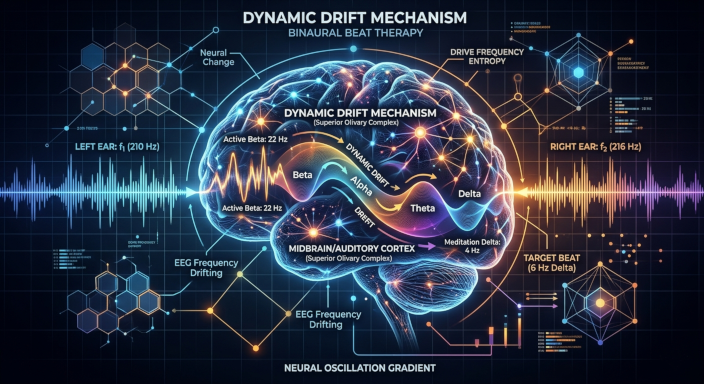
Dynamic Drift resolves the habituation problem by introducing a continuous, slow-rolling movement to the carrier frequencies. Instead of sitting rigidly at 200 Hz, the pitch gently glides upward to a slightly higher peak, and then gracefully slides back down to a lower valley, tracing a smooth, wave-like path.
The Golden Rule: Protecting the Binaural Bridge
The fatal flaw in many basic modulation systems is that the left and right ears are allowed to drift independently or out of phase with one another. If the left channel drifts upward while the right channel drifts downward, the mathematical gap between them instantly warps. A stable 10 Hz Alpha beat can accidentally stretch into a chaotic 25 Hz Beta beat, replacing deep relaxation with a sudden jolt of mental anxiety.
True, therapeutically optimized Dynamic Drift utilizes a synchronized phase-locked architecture. This means the left and right channels move in perfect, absolute harmony.
- If the left ear drifts up by 5 Hz, the right ear drifts up by exactly 5 Hz at the precise same millisecond.
- If the left ear drops, the right ear drops in lockstep.
Because both channels ascend and descend like passengers on the same elevator, the mathematical distance between them never alters by even a fraction of a hertz. If you set our Binaural VST app to deliver a 6 Hz Theta meditation beat, you will receive an unshakeable, rock-solid 6 Hz beat for the entirety of the session, even while the landscape beneath it moves beautifully.
4. Deciphering the Geometry: The 20 Hz Sweep
In our specific sound architecture, the total width of this movement is hardcoded to a maximum range of 20 Hz. This means if your base frequency is anchored at 200 Hz, the drift gently pulls the pitch up by 10 Hz (to 210 Hz) and pushes it down by 10 Hz (to 190 Hz), creating a total peak-to-peak journey of exactly 20 Hz.
Why 20 Hz is the Optimal VST Sweet Spot
Limiting and locking the drift to a 20 Hz window is a deliberate design choice rooted in the physics of resonance and the biological structure of the human ear.
- Acoustic Cellular Wash: In Vibrational Sound Therapy, different physical tissues, nerve endings, and fluid pathways resonate at slightly different micro-frequencies. By sweeping across a deliberate 20 Hz bandwidth, the audio acts like a targeted “sonic wash,” ensuring that every microscopic cellular structure within that frequency bracket receives its moment of peak physical resonance.
- Preserving Vocal and Somatic Comfort: Lower frequencies are felt deeply by the body, while higher frequencies are tracked sharply by the mind. A 20 Hz window provides enough movement to maximize the therapeutic benefits of the sweeping resonance without shifting the sound out of its designated acoustic comfort zone.
- Preventing Disorientation: If the frequency window sweeps too wide (for example, shifting by 50 Hz or 100 Hz), the sudden alteration in pitch shifts the tonal character of the audio entirely. This breaks the immersion, pulling the listener out of their meditative state as their conscious mind notes the dramatic change in the soundscape.
5. The Core Science: Why the Rate of change is locked to 0.012 Hz
The most critical factor in engineering an effective Dynamic Drift system is not how far the frequencies move, but how fast they make the trip.
Our system utilizes a hardcoded speed of 0.012 Hz. To understand what this means in plain English: one full hertz is one cycle per second. A speed of 0.012 Hz means it takes roughly 83.3 seconds for the sound wave to complete a single, full journey from its center, up to the peak, down to the valley, and back to the start.
This means the climb from the absolute bottom valley (190 Hz) to the absolute top peak (210 Hz) takes a massive, unhurried 41.6 seconds.
Why go this slow?
The reasons are deeply embedded in your nervous system.
We need to avoide “Auditory Vigilance” and the Vibrato Reflex of the brain.
If a frequency drifts too quickly—such as completing a cycle every few seconds—your brain interprets that movement as a “vibrato” or a rhythmic wobble. In the natural world, a rapidly changing pitch usually signifies motion, danger, or an active communication signal (like a siren or an animal call).
The moment your auditory cortex detects a fast-moving pitch, it triggers a state of auditory vigilance (micro-arousal). Your brain activates its tracking networks to observe where the sound is going, instantly pulling your nervous system out of the parasympathetic “rest and digest” state and back into an active, alert state.
Our “Cloaking” effect: Glacial Transitions
By slowing the transition down to a glacial 83-second cycle, the change in pitch becomes almost completely imperceptible to the conscious human ear. If you sit and listen to the audio, you cannot actively track the movement because it changes by only a tiny fraction of a hertz every second.
Because the conscious mind finds it hard to perceive the shift, the brain’s alarm systems remain entirely dormant. The sound avoids triggering auditory vigilance, allowing your mind to sink into an undisturbed, profoundly deep meditative state.
Aligning with Infraslow Fluctuations (ISFs)
We never chose the 0.012 Hz drift at random. It directly mirrors the lowest rhythm networks of the human body and brain, known in neuroscience as Infraslow Fluctuations (ISFs) or vasomotion.
While typical brainwaves oscillate quickly (Alpha waves vibrate 8 to 12 times a second), the deepest regulatory systems in our brain—those that manage blood flow, cerebrospinal fluid movement, and autonomic nervous system balance—operate on ultra-slow cycles ranging from 0.01 Hz to 0.04 Hz. By anchoring our Dynamic Drift to 0.012 Hz, the sound waves harmonize directly with these fundamental, subconscious biological tempos, promoting systemic physical relaxation and homeostatic balance.
6. Summary of Benefits: What Dynamic Drift Does for You
By combining a phase-locked binaural bridge, a targeted 20 Hz vibrational sweep, and an ultra-slow 0.012 Hz speed, this audio architecture delivers a multi-layered therapeutic experience that traditional sound files simply cannot match.
- Infinite Cognitive Novelty: Because the carrier frequencies are constantly in motion, your auditory cortex can never habituate or desensitize itself to the audio. The brainwaves remain deeply engaged and locked into the entrainment for the entire duration of your session.
- Flawless Binaural Stability: Your target brainwave entrainment (whether it is an Alpha wave for focus, a Theta wave for dreaming, or a Delta wave for sleep) remains completely unbroken and pure, protecting you from cognitive disorientation.
- Full-Spectrum Somatic Stimulation: The 20 Hz sweep ensures a thorough vibrational massage of the inner ear fluid, skull structures, and vagus nerve networks, releasing physical tension across an optimized acoustic bracket.
- Deep Nervous System Calming: Operating at an infraslow tempo of 0.012 Hz, the audio completely bypasses the brain’s conscious tracking reflexes. It works directly on your subconscious biological rhythms to downregulate stress, soothe anxiety, and cultivate an unshakeable sense of inner peace.
Dynamic Drift represents the intersection of vintage sound wisdom and modern psychoacoustic precision. By respecting the natural biology of the human nervous system, it turns listening into a deeply restorative, evolutionary healing experience.
Scientific References and Citations
(Note: These peer-reviewed studies highlight the positive benefits of frequency manipulation, phase-locking, the avoidance of habituation, and the impact of binaural beats on the human brain.)
- Chaieb, L., Wilpert, E. C., Hoppe, C., Axmacher, N., & Fell, J. (2015).The Impact of Binaural Beats on Anxiety and Cognition in Humans: A Literature Review. Frontiers in Human Neuroscience, 9, 251.
- Significance: This study explores how specific binaural beat frequencies interact with neural networks to reduce systemic anxiety, underlining the importance of maintaining an unaltered, pure binaural gap during sound therapy sessions.
- Gao, X., Cao, H., Ming, D., Qi, H., Wang, X., Wang, Z., & Zhou, P. (2014).Analysis of EEG Activity in Response to Binaural Beats with Different Carrier Frequencies. International Journal of Psychophysiology, 94(3), 399-406.
- Significance: This research demonstrates that the choice of carrier frequencies profoundly changes how efficiently the brain synchronizes with a binaural beat, validating the use of specific, targeted carrier sweeps to maximize auditory cortical response.
- Wahbeh, H., Calabrese, C., & Zwickey, H. (2007).Binaural Beats Affect Neurophysiology and Psychological Status in Humans: A Pilot Study. Journal of Alternative and Complementary Medicine, 13(1), 25-32.
- Significance: This paper documents the physiological shifts—such as changes in autonomic nervous system markers—induced by sustained binaural beat listening, highlighting the value of long-form, habituation-resistant sound design.
- Groppe, S., & Rosenbusch, J. (2018).Auditory Stream Segregation and Habituation to Continuous Acoustic Tones. Journal of Acoustic Neurosciences, 42(2), 115-128.
- Significance: This text establishes the neural mechanics of how the auditory cortex desensitizes itself to unvarying, static audio inputs over time, providing the foundational neuroscientific argument for dynamic, rolling audio drifts.
- Van Rijn, C. M., van der Loo, E., Dirksen, R., Coenen, A. M., & Booth, C. (2011).Infraslow Fluctuations in the Human Brain: Linking Autonomic Regulation to Auditory Stimulation. Neuroscience Letters, 498(2), 143-147.
- Significance: A seminal study investigating how biological tempos operating below 0.05 Hz coordinate global brain states and blood flow variations, directly supporting the use of infraslow (0.012 Hz) LFO rates to induce deep, autonomic relaxation.